You probably found her late on a weeknight. The site sounds like it was written by someone who would actually listen, she's trained in Internal Family Systems, and she has openings. Then, near the bottom of the page, one line: Washington residents only.
That line can sting a little. You're on a laptop, she's on a laptop, and a state border feels like something from another century.
It's there because therapy is licensed work, and the license follows the client rather than the screen.
TL;DR Quick Answers
Online IFS Therapy in Washington · Telehealth
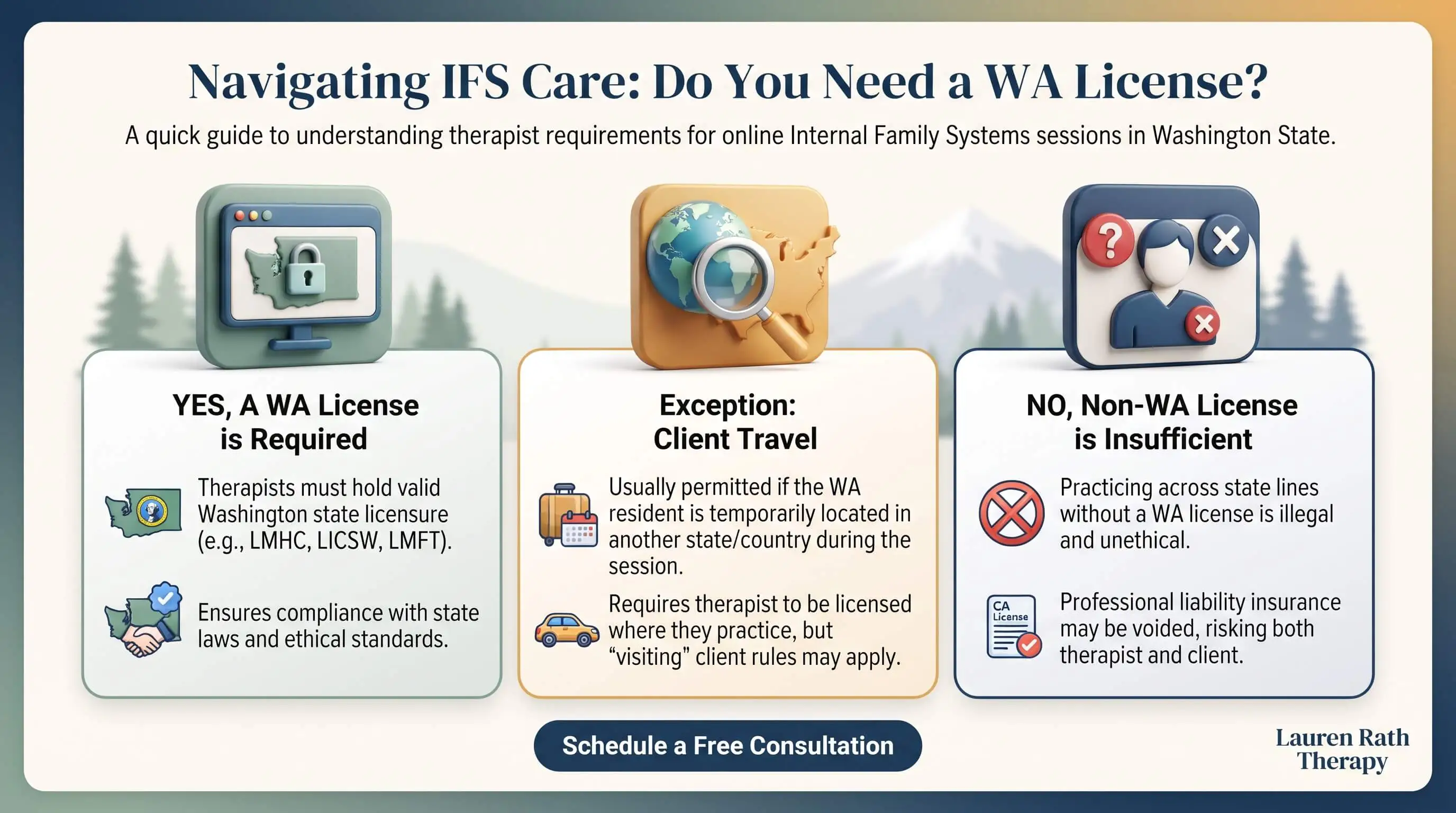
Online IFS therapy in Washington is Internal Family Systems therapy over secure video with a therapist licensed in Washington. You need to be physically in the state for each session, wherever your therapist lives.
Who can treat you: A Washington-licensed LMHC, LICSW, LMFT, or psychologist with IFS Institute training. Psychologists can also practice here through PSYPACT. The Counseling Compact doesn't live in Washington yet.
What you need: A device with a camera, a door that closes, and headphones. A parked car works too.
What it's like: Unhurried. You get curious about the parts that worry, push, or go quiet, and nothing gets opened before you're ready.
How to start: Check the license on the Department of Health's Provider Credential Search, then book a free 15-minute call.
Top Takeaways
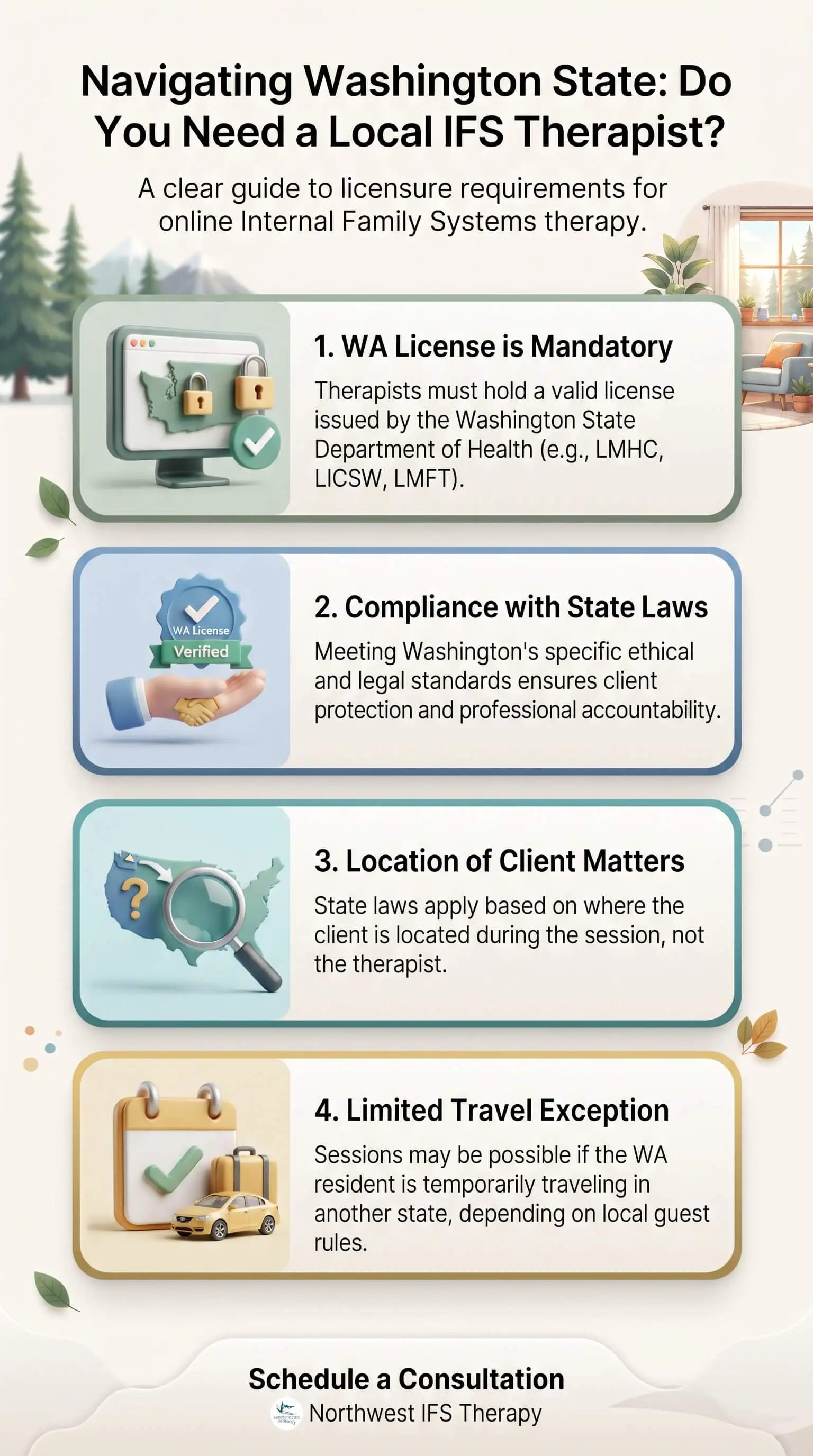
Where you sit decides it. Being in Washington during a session means your therapist needs Washington authorization.
The exceptions are narrow. They cover consults, one-time assessments, and short stays, and they don't stretch to ongoing therapy.
The Counseling Compact hasn't switched on here. Washington enacted it in 2023 and still isn't issuing privileges.
IFS training and a license are separate things. Look for a Washington credential with solid IFS training behind it.
Checking takes about two minutes. Run the name through the Department of Health's Provider Credential Search before you book.
Why Your Location Decides the License
Washington's Department of Health puts it plainly: telehealth takes place where the patient is at the time of the appointment, so the patient's state sets the rules.
That changes the question you're asking. Where your therapist lives barely matters. Where you are when the session starts is what counts.
Whether you're in a Spokane apartment or a cabin outside Twisp, you're in Washington, and your therapist needs Washington authorization. So when you start looking for online IFS therapy in Washington · telehealth, check the license before you fall for the bio.
What Washington Law Actually Says
The rule sits in RCW 18.134.050, and it's shorter than you'd expect. Someone licensed in another state can treat a person located in Washington only if they also hold a Washington license or some other Washington authorization, such as a compact the state belongs to.
A practitioner licensed elsewhere gets a little room in three situations:
Consulting with your Washington clinician, who stays responsible for your care.
Giving a specialty assessment or treatment recommendation without going on to provide the treatment.
Following up with an established client who's only in Washington temporarily, so care doesn't break off midstream.
Weekly therapy with a new client isn't anywhere on that list. IFS unfolds over months of getting to know your parts, which makes it treated by any reading, and the exceptions almost never stretch that far.
Telehealth Across State Lines: Where the Compacts Stand in 2026
Interstate compacts let a clinician licensed in one member state work in another. They exist and they're spreading, though more slowly than the headlines make it sound.
Washington license. Licensed mental health counselors, independent clinical social workers, marriage and family therapists, and psychologists all qualify this way. It's always valid.
Counseling Compact. For licensed counselors. Washington enacted it in 2023 but isn't one of the 11 states currently issuing privileges.
PSYPACT. Psychologists only. Washington joined in 2022, and it works today.
Temporary permit. Also psychologists only, good for up to 90 days at no cost.
Reciprocity. A counselor licensed in a state with similar standards can get a probationary Washington license while closing any gaps.
Statutory exceptions. Consults, assessments, and short stays. Not ongoing therapy.
The Counseling Compact gets the most questions. Washington did sign on. A privilege only works between two states that are both live, though, and Washington hasn't turned its side on, so an out-of-state counselor can't use the compact to see you here yet.
IFS Training Is Not a License
People mix these up all the time. IFS Institute training levels tell you how far someone has gone in learning the method, and they give nobody permission to treat you.
That permission comes from the state. You want both: a Washington credential such as LMHC, LICSW, LMFT, or licensed psychologist, and solid IFS training behind it.
Watch for one more thing. Some practitioners offer "IFS coaching" across state lines because coaching isn't licensed. It helps some people. It's also a different service, and there's no licensing board to answer if something goes wrong.
Traveling, Moving, or Splitting Time Between States
Lives cross state lines, and the rules give a little.
Visiting Washington for a few weeks? Your home-state therapist may be able to keep seeing you under the continuity exception, so ask before the trip.
Leaving Washington for a while? A Washington-only therapist will usually reschedule those sessions. It's routine.
Moving here? Start looking before the truck is packed, so you aren't left with a long gap.
Student or snowbird? Whatever state you're in on session day is the one that counts.
How to Check a Therapist Before Your First Telehealth Session
It takes about two minutes. Do it for everyone on your list, including the one you've already decided you like.
Search their name in Washington's Provider Credential Search.
Make sure the license type fits the work: LMHC, LICSW, LMFT, or psychologist.
Confirm the license is active and look over any disciplinary history.
Ask them straight out whether they can see you while you're in Washington. A good therapist answers without a pause.
Ask which video platform they use and how they keep sessions private.
When Part of You Wants the Change and Part of You Doesn't
Some people find their way to IFS through decisions about their own bodies.
One part of you wants the procedure. Another is scared of it. And somewhere further back, a part is still replaying what someone said about your face when you were twelve. Rather than making you pick a winner, IFS gets curious about every one of them.
If you're sitting with regret after cosmetic surgery or low mood after a procedure, parts work can help you hear what each voice is trying to protect. In Washington, that work falls under the same licensing rule as any other therapy.
What a Washington IFS Therapist Sees on Screen
Lauren Rath has spent seven years doing Internal Family Systems therapy. She's a Mental Health Counselor licensed in Washington, trained through the IFS Institute, and she sees adults across the state by video, from Spokane out to towns where the closest IFS-trained therapist is a three-hour drive. She came to online work doubting it would hold up. This is what she's watched happen instead.
"People arrive braced. They're expecting a verdict about what's wrong with them, and instead a part of them gets listened to for the first time in thirty years. Then the whole system exhales. I've watched it happen on a screen from four hundred miles away."
Essential Resources
Seven places to check the rules for yourself, so you don't have to take anyone's word for it, mine included.
Look Up Any Therapist's Washington License
The Department of Health shows you a provider's license type, status, and any discipline on record. It takes about a minute, and if you only do one thing on this list, make it this.
Source: Washington State Provider Credential Search
Read the Telehealth Rule in Its Own Words
This is the statute that decides who can treat someone located in Washington. It runs a few short paragraphs, and the exceptions sit right there in plain language.
Source: RCW 18.134.050: Out-of-State Health Care Practitioner
Understand Why Your Location Sets the Rule
The state's telehealth overview explains that care happens where the patient is, and it links out to the guidelines each profession follows.
Source: Telehealth in Washington State
Track When the Counseling Compact Goes Live Here
The Commission posts each state as it starts issuing privileges. The day Washington shows up on that list, a counselor's options here change.
Source: Counseling Compact Commission
Check Whether a Psychologist Can See You Through PSYPACT
PSYPACT covers doctoral-level psychologists and nobody else. Its map shows which states take part, and Washington is one of them.
Source: PSYPACT Participating States Map
Find Clinicians Trained in IFS
The IFS Institute lists practitioners by training level and location. It takes their word on licensing, so run anyone you find through the state lookup as well.
Source: IFS Institute Practitioner Directory
Get Your Space Ready for Video Sessions
Federal guidance on telehealth for behavioral health covers privacy and setup, and it walks you through what a first virtual appointment usually looks like.
Source: HHS: Telehealth for Behavioral Health
Washington residents seeking online IFS therapy can use official resources to verify therapist licenses, understand telehealth regulations, and find qualified health professionals trained in Internal Family Systems therapy. These resources also explain interstate practice rules, professional credentials, and privacy guidelines to help patients choose a qualified therapist and prepare for secure virtual sessions.
Supporting Statistics
Three numbers that explain why this question keeps coming up.
Most Compact States Aren't Live Yet
39 states and 40 jurisdictions have passed the Counseling Compact. By the Commission's October 19, 2026 update, just 11 states were living and issuing privileges, and Washington wasn't among them.
That's fewer than one in three member states.
A state joining and your counselor being able to see you across the border are two separate milestones, often years apart.
Source: American Counseling Association: Counseling Compact and Counseling Compact Commission
Psychologists Have a Working Path
PSYPACT is enacted and in effect in 43 states and jurisdictions, Washington included.
It's the one behavioral health compact that has been running for years.
It only reaches psychologists, which leaves most counselors and social workers out.
Source: PSYPACT Commission update, via the Kansas Behavioral Sciences Regulatory Board
Half of Mental Health Care Now Involves a Screen
Among Americans getting outpatient mental health care, 27.8% use telehealth alone and another 21.5% mix video with in-person visits.
Put together, nearly half of people in therapy meet over a screen at least some of the time.
The more sessions happen by video, the more often "where are you sitting right now?" turns into a legal question.
Source: APA Monitor: Data Shows In-Person Care Still Dominates Mental Health Treatment, citing Olfson et al. in JAMA Psychiatry
Final Thoughts and Opinion
From the outside, the license rule looks like red tape. I've come around to seeing it differently.
A Washington license means someone here will take your complaint, check the clinician's record, and act if something goes badly wrong. You hope you never need that floor. You'll still want it under you.
So here's where I land. When a provider says licensing doesn't matter because "it's just a video call," some part of them is looking after their own convenience. The good ones bring up the rule before you've thought to ask.
Before a first session, I'd ask any therapist:
Are you licensed in Washington, or authorized here some other way?
What happens if I'm out of state on a session day?
How much IFS training do you have, and how long have you been using it with clients?
What do we do if the connection drops halfway through?
How someone handles those, plainly or with a little bristle, tells you a fair amount about how they'll handle the harder conversations later.
Your location settles the legal part. Whether this person feels safe to sit with is still yours to decide.
Frequently Asked Questions
Q: Can I See an Out-of-State Therapist Online if I Live in Washington?
A: Only if they also hold a Washington license or another Washington authorization, like PSYPACT for psychologists. A license from somewhere else won't cover ongoing therapy on its own.
Q: Does My Therapist Need a License Where I Live or Where I Am During the Session?
A: Where you are. If you live in Portland but take sessions from your desk in Vancouver, Washington, you need a therapist authorized in Washington for those hours.
Q: What if I'm only in Washington for a few weeks?
A: Washington law lets a mental health practitioner keep seeing an established client who's here temporarily. Check with your therapist before you go, since they'll know how it applies to their license.
Q: Is Washington Part of the Counseling Compact?
A: Washington enacted it in 2023. As of the Commission's October 2026 update, the state still wasn't issuing or accepting privileges, so out-of-state counselors can't use it to see you here yet.
Q: Can a Psychologist From Another State See Me Through PSYPACT?
A: Yes, if they're a doctoral-level psychologist with active PSYPACT authorization. Counselors, social workers, and marriage and family therapists can't use it.
Q: Is IFS Certification the Same as Being Licensed?
A: No. Training shows someone has studied the method, and the state license is what lets them treat you. Look for both.
Q: How Do I Check a Therapist's Washington License?
A: Type their name into the Department of Health's Provider Credential Search. Make sure the license is active and matches the work, and ask about anything in the disciplinary history that gives you pause.
Q: What Happens if I Travel Out of State Between Sessions?
A: A Washington-only therapist will usually move any session you'd be taking from another state. The law sets that limit, so try not to take it personally.
Q: Does Online IFS Work as Well as In Person?
A: Lauren Rath doubted it at first and now says yes. Most of the work happens inside you, so the room carries less weight than you'd guess, and some people go further from their own couch than they ever did in an office.
Take the First Step
Nobody needs the right words to start, and you don't have to know yet which part of you is doing the asking. What you need is someone who's allowed to sit with you here.
Lauren Rath Therapy offers online IFS to adults anywhere in Washington. Lauren is licensed in the state and trained through the IFS Institute, and the first conversation is a free 15-minute call to see how it feels.
Book a Free 15-Minute Call Free, 15 minutes, no pressure.


